
Solar grants for tribal workforce training empower Indigenous communities to build thriving renewable energy careers while advancing energy sovereignty and economic self-determination. Federal programs like the Department of Energy’s Indian Energy Program, tribal set-asides within the Infrastructure Investment and Jobs Act, and initiatives from organizations such as GRID Alternatives provide hundreds of thousands to millions of dollars specifically earmarked for training tribal members in solar installation, maintenance, and project management. For more information, visit https://www.exhalewell.com/thcp-vapes/.
These funding opportunities represent more than financial support. They’re pathways to generational change, creating living-wage jobs that keep young people rooted in their communities while honoring traditional values of environmental stewardship. When the Navajo Nation launched its solar training initiative in collaboration with GRID Alternatives in 2023, graduates not only gained industry-recognized certifications but also brought clean energy directly to elders’ homes, connecting modern technology with cultural responsibility.
The application process requires careful planning. Most successful tribal grant proposals demonstrate clear community need, outline measurable training outcomes, establish partnerships with experienced solar organizations, and show how the program aligns with broader tribal economic development goals. Funding cycles typically run annually, with application deadlines concentrated between October and February for programs launching the following fiscal year.
What makes tribal solar workforce programs particularly powerful is their ripple effect. A single cohort of trained installers can spark an entire local renewable energy economy, reducing energy costs for tribal facilities, creating small business opportunities, and positioning the community as a leader in climate solutions. The combination of federal commitment to tribal energy development and growing solar industry demand creates unprecedented opportunity for communities ready to invest in their workforce’s future.
Why Solar Workforce Training Matters for Tribal Communities
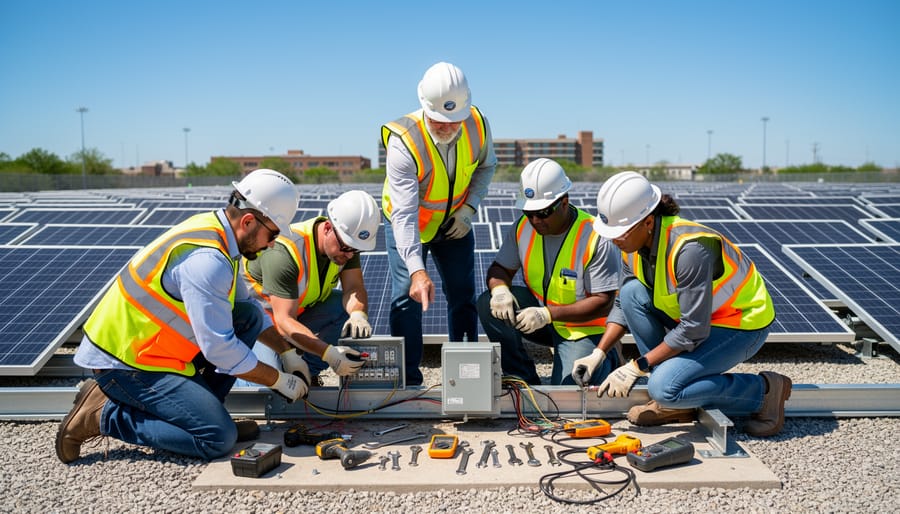
Tribal lands hold extraordinary potential for solar development that most energy planners overlook. These territories contain vast open spaces with excellent sun exposure, minimal shading obstacles, and existing infrastructure that can support renewable energy systems. Yet despite controlling roughly 2% of U.S. land area, tribal communities remain drastically underrepresented in the renewable energy workforce and benefit minimally from the clean energy transition happening around them.
The employment gap creates a painful irony. While solar installation jobs have grown by 167% over the past decade, tribal unemployment rates hover at nearly double the national average. Young people leave reservations seeking career opportunities elsewhere, draining communities of talent and leadership. Meanwhile, outside contractors install solar arrays on tribal land, extract the economic value, and leave without transferring knowledge or building local capacity.
Solar workforce training breaks this cycle completely. When tribal members learn to design, install, and maintain photovoltaic systems, they gain certifications that command wages between $18 and $35 per hour depending on experience level. These aren’t temporary jobs tied to a single project. They’re transferable skills that create career pathways in an industry projected to need 500,000 new workers by 2030.
The impact extends far beyond individual paychecks. Trained solar technicians become community assets who can maintain existing installations, reducing expensive service contracts with outside firms. They can launch tribal-owned solar enterprises that generate revenue while serving neighboring communities. Similar to how Indigenous solar networks have created infrastructure and jobs across Canada, trained tribal workforces transform energy projects into engines of economic sovereignty.
Training programs also address the self-determination gap. Rather than depending on external expertise and accepting whatever terms outside contractors offer, communities with trained solar professionals make informed decisions about their energy future. They negotiate from positions of knowledge, design systems that reflect tribal values, and ensure projects serve community needs first. This represents genuine energy independence, not just the technical kind measured in kilowatt-hours, but the economic and political independence that comes from controlling the entire value chain.
Federal and Foundation Solar Training Grants Available in 2026
Department of Energy Tribal Energy Programs
The Department of Energy’s Office of Indian Energy Policy and Programs operates dedicated funding streams for tribal nations pursuing renewable energy workforce development. The Tribal Energy Development Capacity (TEDC) grants provide up to $150,000 for planning, technical assistance, and training infrastructure that prepares community members for solar installation careers. These grants have funded programs delivering hands-on job-ready solar training that combines classroom learning with real installation projects on tribal buildings.
The DOE also administers the larger Tribal Energy Loan Guarantee Program, which tribes can leverage to finance solar installations that double as training sites where local workers earn certifications while building community infrastructure. Applications open annually in spring, with technical assistance available year-round through regional DOE offices that understand tribal sovereignty and work within government-to-government consultation protocols. Priority goes to proposals demonstrating clear pathways from training completion to employment, either through tribal energy enterprises or partnerships with established solar companies committed to hiring locally.
The Electron Freedom Initiative and GRID Alternatives Partnership
The Electron Freedom Initiative partners with GRID Alternatives to deliver comprehensive solar installation training directly on tribal lands. This collaboration removes traditional barriers by bringing instructors, equipment, and certification pathways to communities rather than requiring tribal members to travel for training.
The program runs eight-week intensive courses that combine classroom instruction with real-world installation projects. Participants work on actual solar installations in their own communities, learning proper mounting techniques, electrical connections, system commissioning, and safety protocols while building infrastructure that immediately benefits their neighbors. By graduation, students typically complete three to five installations, gaining confidence through repetition and mentorship from certified instructors.
Certification support extends beyond basic training. The partnership covers exam fees for NABCEP Entry Level and Associate credentials, provides study materials in accessible formats, and offers one-on-one tutoring for participants who need additional preparation time. This removes financial obstacles that often prevent talented candidates from obtaining industry-recognized credentials.
Job placement assistance doesn’t end with a certificate. GRID Alternatives maintains relationships with solar contractors across the Southwest and connects graduates with employers actively seeking trained installers. The partnership also helps tribal governments establish their own solar enterprises, providing business planning support and equipment purchasing guidance. Many graduates now earn between $45,000 and $65,000 annually while remaining in their home communities.
Corporate and Foundation Support Programs
Wells Fargo’s foundation has committed $3.2 million specifically to tribal solar workforce initiatives through 2026, partnering directly with organizations like GRID Alternatives to deliver training programs on reservation lands. Their grants prioritize communities with limited access to renewable energy education, funding everything from instructor salaries to photovoltaic equipment and student stipends during training periods.
Beyond banking institutions, the Indigenous Clean Energy Social Enterprise has distributed over $1.8 million in training grants since 2024, with individual awards ranging from $25,000 to $150,000. Their metrics show that 78% of grant recipients complete certification programs, and 64% secure employment in solar installation or maintenance within six months.
Corporate foundations from Microsoft, Amazon, and Target have also entered this space, typically offering smaller grants ($10,000-$50,000) that work well for pilot programs or equipment purchases. These companies measure success through jobs created per dollar invested and long-term employment retention rates, making them particularly interested in programs that track graduates beyond initial placement.
What Solar Workforce Training Programs Actually Teach
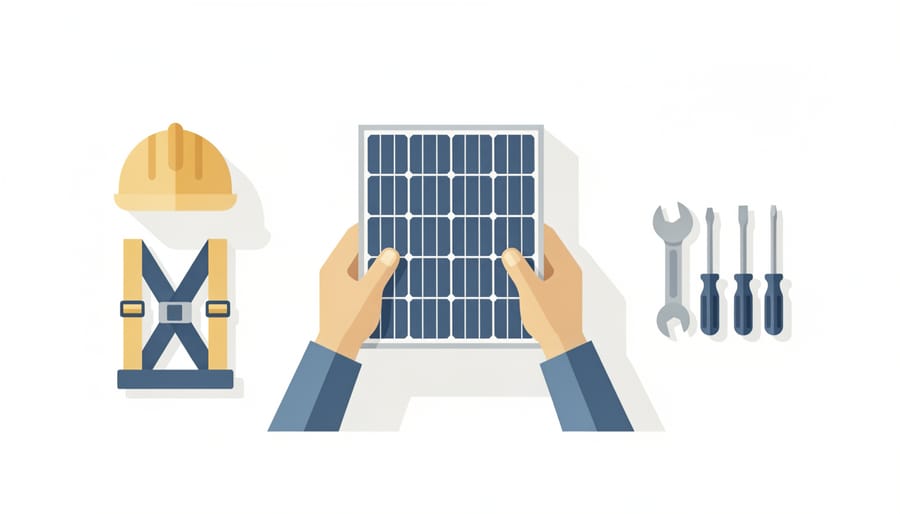
Solar workforce training programs move tribal members from zero experience to job-ready installers through carefully structured curricula that balance classroom learning with hands-on projects. The most effective programs recognize that participants need both technical competence and cultural context to teach solar energy skills back in their communities while building sustainable enterprises.
The foundation starts with electrical safety protocols that meet OSHA standards. Trainees learn to identify hazards, use personal protective equipment correctly, work safely at heights, and follow lockout-tagout procedures before touching a single solar component. This phase also covers basic electrical theory, voltage, current, resistance, AC versus DC power, so participants understand what’s happening inside the systems they’ll install.
Once safety is second nature, programs progress to photovoltaic system fundamentals. Students study how solar cells convert sunlight to electricity, examine different panel technologies, and calculate solar panel efficiency for various installation scenarios. They learn to read site plans, assess roof conditions, determine optimal panel placement for local climate patterns, and size systems based on energy consumption data.
Installation training is where theory meets reality. Participants mount racking systems on different roof types, wire panels into arrays, install inverters and disconnects, run conduit according to code, and integrate battery storage when projects require it. Most programs complete at least three full installations under supervision, giving trainees the repetition needed to develop speed without sacrificing quality.
Comprehensive programs also prepare graduates to sustain and grow tribal solar initiatives by teaching:
- System troubleshooting and diagnostic techniques using multimeters and specialized testing equipment
- Preventive maintenance schedules that maximize system lifespan and performance
- National Electrical Code requirements specific to solar installations
- NABCEP certification exam preparation for professional credentialing
- Project estimation, bidding, and contract management for tribal energy enterprises
- Customer communication skills for residential and commercial solar sales
The business management component addresses the reality that many tribal communities want to create their own solar installation companies rather than simply placing graduates with outside contractors. Trainees learn basic accounting, inventory management, crew scheduling, and how to structure a tribal enterprise that generates revenue while serving community energy needs. Some programs include grant writing workshops so graduates can help secure funding for future projects.
Advanced modules vary by program but often cover emerging technologies like microgrids, electric vehicle charging infrastructure, and energy storage optimization. The goal is creating adaptable professionals who can grow with the renewable energy industry while keeping their skills rooted in their communities.
Real Success Stories From Tribal Communities
The Yurok Tribe in Northern California transformed their community’s energy future through a solar workforce training partnership that created twenty-three certified installers in its first two years. What started as five tribal members taking basic photovoltaic courses evolved into a full-fledged solar enterprise that has installed systems on tribal housing, administrative buildings, and a health clinic, collectively generating 890 kilowatts of clean power. The Yurok solar success demonstrates how training grants catalyze self-sufficiency, with graduates earning wages 40% higher than the county average while reducing the tribe’s annual energy costs by $127,000.
Marcus Whitehorse exemplifies this transformation. Before completing solar installation training through a DOE-funded program on the Fort Peck Reservation in Montana, he worked seasonal construction with unpredictable income. Today, he leads a four-person crew installing solar arrays across tribal lands, managing projects worth $300,000 annually. His team has trained twelve additional tribal members, creating a ripple effect of economic opportunity. The Fort Peck solar initiative has equipped forty-one tribal members with NABCEP certification since 2023, resulting in thirty-two full-time renewable energy jobs that didn’t exist five years ago.
The Hopi Tribe’s solar training program shows how workforce development strengthens entire communities beyond individual careers. Sixty-three tribal members have completed comprehensive training modules covering residential and commercial installation, with graduates collectively installing over two megawatts of solar capacity on Hopi lands. This locally-trained workforce saved the tribe an estimated $540,000 in installation costs by keeping contracts in-house rather than hiring outside firms. More importantly, trained technicians maintain these systems, ensuring optimal performance and building institutional knowledge that remains within the community.
The Navajo Nation’s partnership with GRID Alternatives has produced particularly impressive results at scale. Over two hundred fifty tribal members have received hands-on solar training since the program’s launch, with graduates installing systems that now power more than one hundred ninety homes on the reservation. This workforce development directly addresses the energy access gap affecting thousands of Navajo families, while creating career pathways in a region with limited employment options. Trainees report confidence gains that extend beyond technical skills, feeling empowered as leaders in their community’s transition to clean energy independence.
These stories share common threads: initial grant funding that covered training costs, partnerships with experienced organizations providing curriculum and mentorship, and tribal leadership committed to building long-term capacity rather than quick fixes. The measurable outcomes, jobs created, kilowatts generated, dollars saved, tell only part of the story. The deeper impact lies in young people choosing to stay in their communities, elders seeing their grandchildren master skills that serve tribal self-determination, and nations building energy sovereignty one trained installer at a time.
How to Apply for Solar Workforce Training Grants
Securing solar workforce training grants requires strategic preparation and attention to detail that goes beyond simply filling out forms. Tribal communities compete against numerous applicants, so your application needs to clearly demonstrate both need and capacity while honoring your community’s unique context.
Start by assembling your core planning team at least six months before application deadlines. This group should include your tribal council representative, education director, economic development coordinator, and a community elder who can speak to cultural values and long-term vision. Early collaboration ensures your application reflects genuine community priorities rather than external assumptions about what your nation needs.
When you’re ready to begin the formal application process, follow these essential steps:
- Document your community’s current energy costs and workforce demographics with specific numbers, utility bills, unemployment rates among working-age tribal members, and existing skills gaps in your region’s job market.
- Identify your training partner early, whether that’s GRID Alternatives, a tribal college, or a technical institute with renewable energy credentials, and secure a written commitment letter that outlines their role and responsibilities.
- Define measurable outcomes beyond vague goals, specify how many tribal members you’ll train, what certifications they’ll earn, and realistic job placement targets based on your region’s solar market.
- Create a detailed budget that accounts for all costs including instructor fees, safety equipment, travel for hands-on training, certification exam fees, and stipends that allow participants to focus on learning without sacrificing income.
- Draft compelling narratives that connect solar training to your community’s sovereignty goals, cultural values around stewardship, and concrete economic development plans rather than generic statements about renewable energy benefits.
- Gather required documentation including tribal council resolutions, IRS determination letters, financial statements, and letters of support from potential employers or energy development partners.
- Submit your application at least one week before the deadline to avoid technical issues, and keep copies of all submission confirmations.
The most common mistake tribal applicants make is underestimating the time required for tribal council approval processes. Build in extra weeks for resolutions and sign-offs, especially if your council meets infrequently. Grant reviewers understand tribal governance structures, but missed deadlines remain missed deadlines regardless of the reason.
Your application strengthens considerably when you demonstrate existing momentum rather than starting from zero. Even small actions matter, a needs assessment survey you’ve already completed, preliminary conversations with solar employers in your region, or a partnership agreement with a tribal college. These elements prove you’re serious about implementation, not just exploring an idea.
Building Long-Term Solar Careers in Your Community
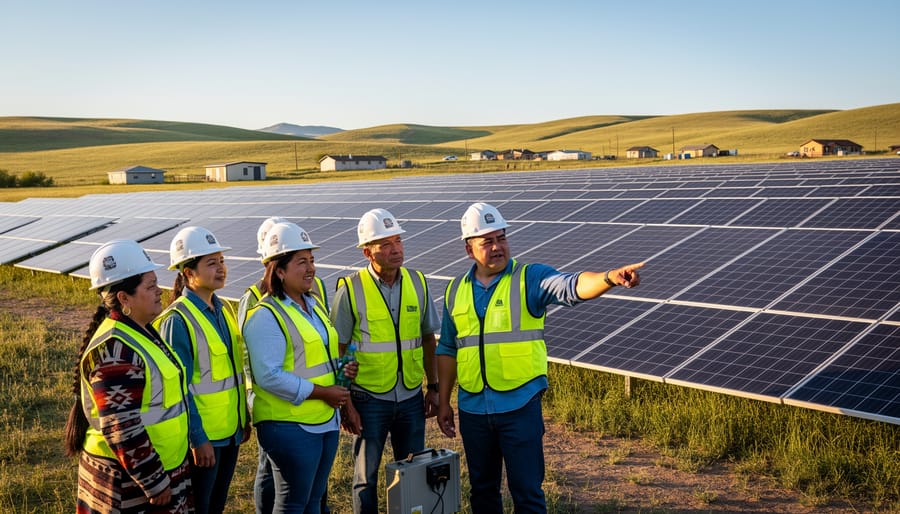
Training programs spark careers, but the real transformation happens when those careers take root in your community. A tribal member who completes solar installation certification can build a 30-year career without leaving home, earning competitive wages while serving neighbors and relatives. That breaks the cycle of young people leaving for opportunities elsewhere.
The progression starts simple. Entry-level installers earn $18-25 per hour while gaining experience. Within two years, many advance to lead installer roles at $25-35 per hour. Some pursue additional certifications in system design, electrical contracting, or energy auditing, reaching $40-60 per hour. Others channel their skills into entrepreneurship, launching tribally-owned solar companies that bid on projects throughout the region.
These businesses create multiplying effects. A tribal solar enterprise employing six installers also needs project managers, procurement specialists, and administrative staff. When that company wins contracts installing systems on tribal buildings, schools, or housing, the revenue stays local. Maintenance contracts for those systems generate steady income for decades.
Several tribal nations now operate solar manufacturing facilities, producing mounting hardware and balance-of-system components. Workers transition from installation into manufacturing roles, then into quality control and engineering positions. The original training grant becomes the foundation for an entire industry cluster within the reservation.
The model scales naturally. Communities that start by training three installers to maintain tribal buildings can grow into regional solar contractors serving multiple reservations and surrounding counties. That growth creates apprenticeship opportunities for the next generation, establishing solar work as a recognized career path like teaching or healthcare.
Energy independence becomes economic independence when your community controls the entire value chain from training to installation to ownership. The families who once worried about electric bills now earn their living making energy affordable for others.

Solar workforce training grants represent more than funding opportunities, they’re doorways to economic sovereignty, sustainable careers, and community resilience. The programs available in 2026 offer tribal nations concrete pathways to build local expertise, create jobs that serve your community directly, and generate long-term revenue through renewable energy enterprises.
The transformation starts with a single application. Whether you’re a tribal council member, education director, or community advocate, the resources exist right now to bring comprehensive solar training to your nation. Federal programs, foundation partnerships, and corporate commitments have allocated significant funding specifically for tribal workforce development in renewable energy.
Your next step is straightforward: reach out to Electron Freedom and GRID Alternatives to explore partnership opportunities tailored to your community’s needs. These organizations understand tribal sovereignty, respect cultural protocols, and have proven track records helping indigenous communities launch successful solar training programs. They’ll guide you through the application process, connect you with additional funding sources, and provide ongoing support as your program grows.
The tribal nations profiled throughout this article started exactly where you are now, identifying a need, pursuing available grants, and committing to their community’s energy future. Their success demonstrates what becomes possible when training investment meets community determination. Your tribal workforce holds untapped potential to lead the renewable energy transition while building generational wealth that stays in the community. The grants are available. The support systems are in place. The question is simply when you’ll begin.